




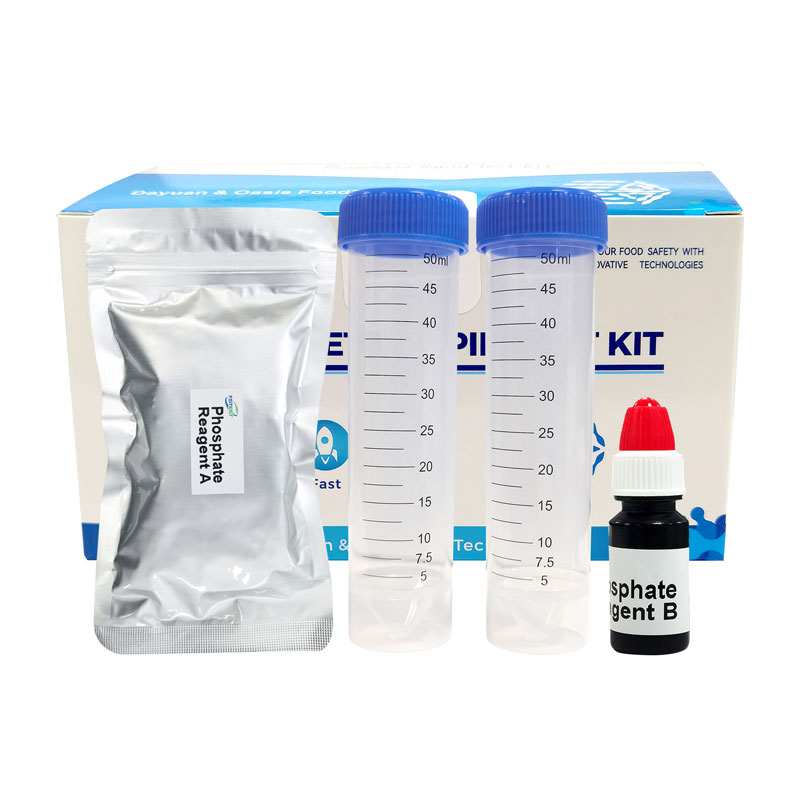


FSTest Phosphate Rapid Test Kit: Professional On-Site Detection for Seafood & Meat
Ensure food safety and regulatory compliance with the FSTest Phosphate Rapid Test Kit. Designed for the rapid screening of food additives and moisture retainers, this kit offers a highly sensitive, cost-effective solution for on-site phosphate level monitoring in various food matrices.
Why Monitor Phosphate Levels?
Phosphates are widely used in the food industry as acidity regulators, leavening agents, and stabilizers. However, excessive consumption is linked to significant health risks, including:
Ø Calcium-Phosphorus Imbalance: Disrupting the body’s mineral equilibrium.
Ø Cardiovascular Diseases: High serum phosphate is a known risk factor for heart health.
Ø Calcium Deficiency: Potential leaching of calcium from bones.
High-Precision Chemical Colorimetric Detection
Our kit utilizes the advanced chemical colorimetric method (Molybdenum Blue reaction).
Ø Mechanism: Phosphates in the sample react with a specialized chromogenic reagent to form a distinct blue complex.
Ø Quantitative Accuracy: The color intensity is directly proportional to the phosphate concentration, allowing for easy visual determination against a standard colorimetric card.
Product Specifications & Applications
Feature | Details |
Detection Limit | 2g/kg |
Tested Matrices | Seafood: Mackerel, Squid, Shrimp, Pangasius, etc. Livestock/Poultry: Chicken, Duck, Pork, Beef, Mutton |
Kit Capacity | 10 Tests per kit |
Reaction Time | Approximately 3 minutes |
Storage | 4−30∘C (12-month shelf life) |
Key Features & Benefits
² Rapid On-Site Testing: Eliminate the wait for lab results with a streamlined 3-minute reaction time.
² User-Friendly Workflow: No complex lab equipment required; includes all necessary droppers and centrifuge tubes.
² Versatile Sample Prep: Applicable for both liquid samples (direct testing) and solid samples (simple homogenization).
² Reliable Quality Control: Backed by FSTest’s rigorous manufacturing standards for consistent results.
Simplified Operation Steps
1. Sample Prep: Homogenize 1g of sample with purified water in a 50mL tube.
2. Reagent Activation: Add deionized water and the test supernatant to Phosphate Reagent A.
3. Color Development: Add Phosphate Reagent B, shake, and wait 3 minutes.
4. Result: Compare the tube color against the standard card to determine concentration.


 Log in
