




Why CFU Enumeration Is More Difficult Than It Looks
A CFU is not necessarily one original cell. A visible colony may arise from one cell or from an aggregate. Image analysis can count visible colonies consistently, but it cannot reconstruct the original number of individual cells or remove variation introduced by homogenization, dilution, culture medium and incubation conditions.
Plate density also affects uncertainty. Low counts are more sensitive to random sampling effects, while crowded plates can contain overlapping, merged or spreading colonies. The objective is therefore not to count the maximum number of objects, but to select plates within the validated counting range of the chosen method.
ISO 4833-1:2013 remains current for colony count at 30 °C by the pour-plate technique. ISO/CD 4833 is under development and is intended to replace ISO 4833-1 and ISO 4833-2. These standards reinforce an important principle: the reported result depends on defined culture conditions and method rules, not on image recognition alone.
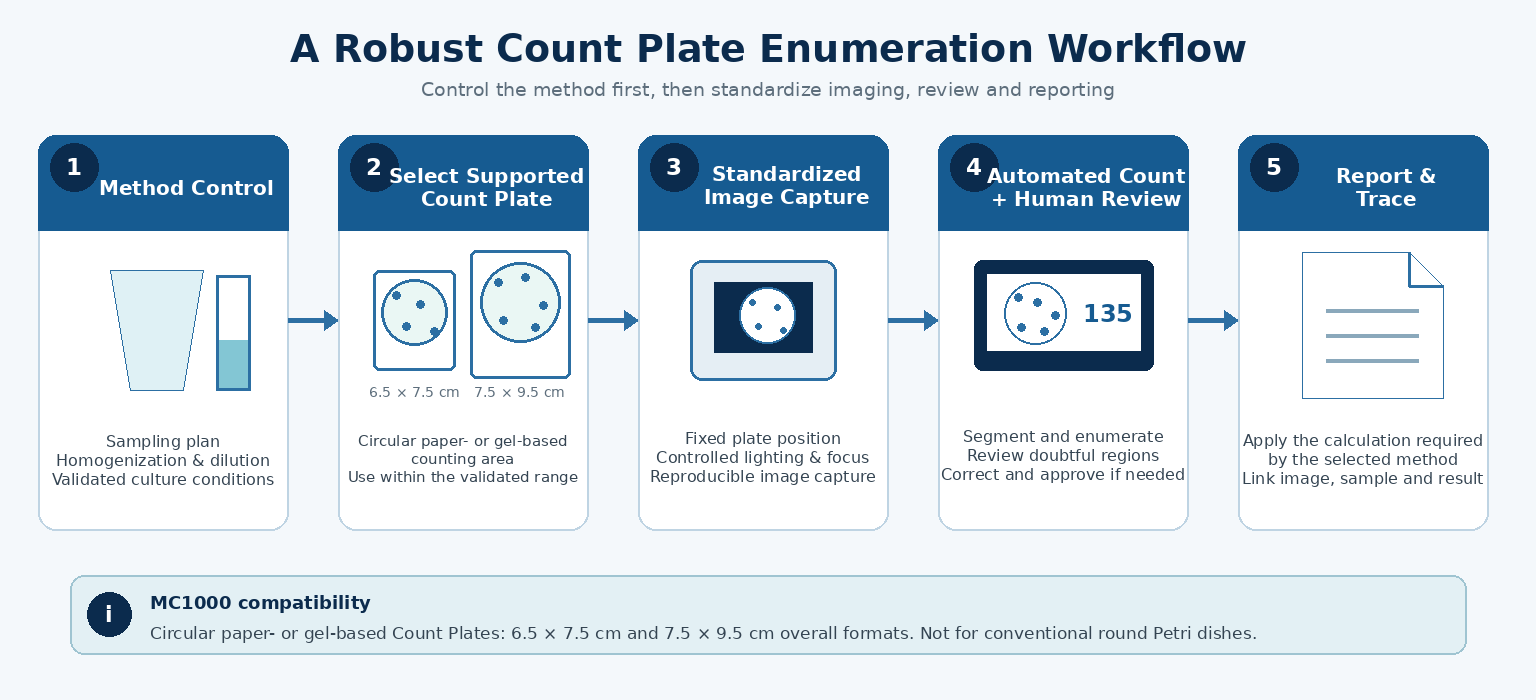
Figure 1. A controlled workflow for automated Count Plate enumeration.
Where Automation Adds Technical Value
Automation is most valuable in laboratories processing many routine Count Plates. A standardized imaging system applies the same recognition logic across successive plates, helping reduce analyst-to-analyst variation caused by fatigue, visual attention and subjective interpretation.
Image-based records can also improve reviewability. When a result is linked to the original plate image, sample identifier and test record, supervisors can review the analytical observation rather than only the final number. However, traceability also depends on documented review procedures, controlled records and appropriate data-management practices.
Counting speed should not be confused with total test turnaround time. Laboratories should evaluate the complete workflow: sample preparation, incubation, plate handling, image acquisition, automated enumeration, verification and reporting.
Verification and Human Review
Before routine use, the laboratory should verify the automated counter for its own Count Plate types, colony morphologies and expected counting ranges. A practical verification plan should assess:
· Agreement with an established manual or reference counting procedure
· Repeatability across repeated images and different operators
· Performance at low, intermediate and high colony densities
· Recognition of small, adjacent, merged or spreading colonies
· Rules for operator review, correction, approval and retained records

FSTest MC1000 for Routine Count Plate Enumeration
The FSTest MC1000 Automatic Colony Counter (Cat. No. 51000) is designed for automated enumeration on compatible Count Plates with circular paper- or gel-based counting areas used in routine food microbiology. Its imaging architecture combines a 13-megapixel camera, controlled illumination and digital image processing for colony recognition, result review and data output.

Under the manufacturer’s specified test conditions, the system has a stated minimum detectable colony size of 0.1 mm and a counting error of ≤5%. These performance claims should be interpreted within the applicable test conditions and supported Count Plate scope. FSTest reports completion of applicable EMC, electrical-safety and RoHS conformity testing for the MC1000 in June 2026.
Conclusion
The future of colony counting is not defined by speed alone. Its practical value lies in combining controlled microbiology with reproducible imaging, automated enumeration, human verification and traceable reporting. This approach can reduce observer variability while preserving the analytical discipline required for reliable CFU results.
For application-specific information, Count Plate compatibility or verification support, contact the FSTest technical team.
References
· FDA — Bacteriological Analytical Manual, applicable enumeration chapter.
· ISO 4833-1:2013 and Amendment 1:2022 — Colony count at 30 °C by the pour-plate technique.
· ISO/CD 4833 — Colony count at 30 °C (under development).
· Zheng M. et al. (2026). Learning to count small and clustered objects with application to bacterial colonies. Preprint.
· FSTest MC1000 Automatic Colony Counter — current product specifications and conformity documentation.


 Log in
