




Building a Risk Based Listeria Monitoring Program for Ready to Eat Foods
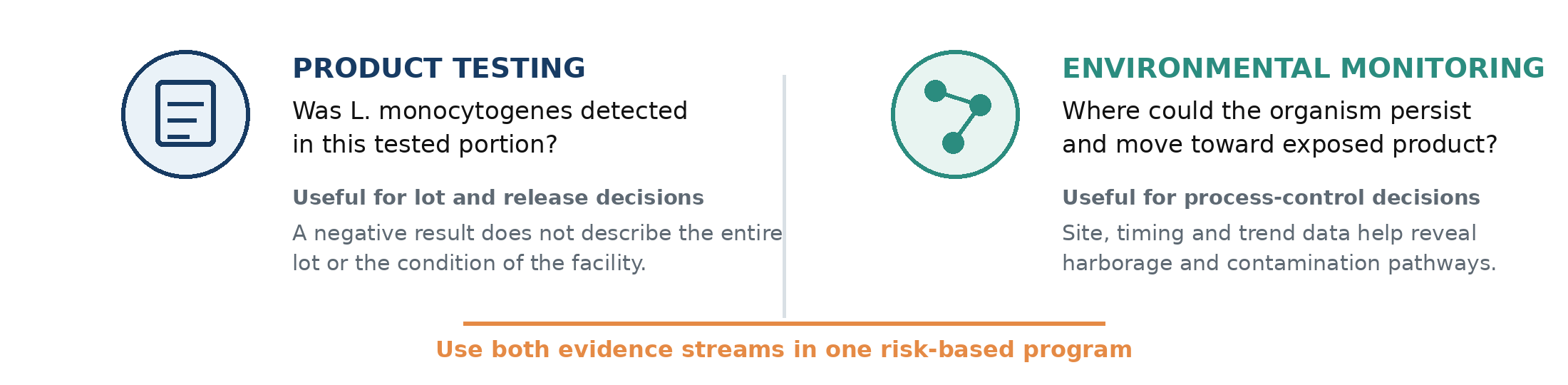
Environmental evidence and product results answer different questions
Listeria monocytogenes can persist in difficult-to-clean sites and reach exposed RTE products after a lethality step. Effective control therefore depends on connected evidence—not simply more finished-product tests.
Two evidence streams answer different questions
A five step monitoring loop
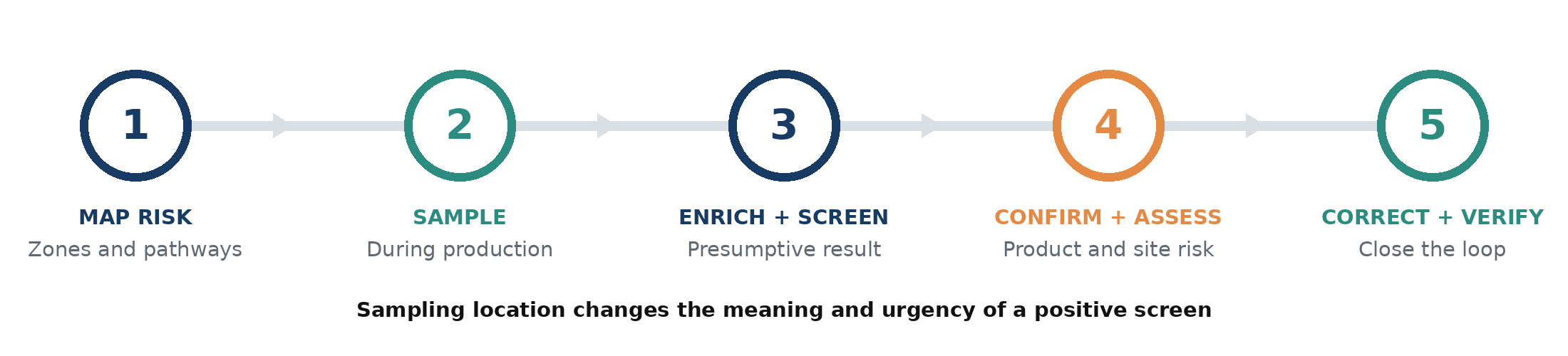
From presumptive result to action

Where the FSTest rapid test fits

The FSTest Listeria monocytogenes Rapid Test Kit (Cat. No. 21202) is a qualitative lateral-flow screening tool for food and environmental samples. After the appropriate enrichment, the strip develops in 10–15 minutes.
Its role: to provide a rapid presumptive decision point within a controlled workflow, while confirmation and corrective-action decisions follow the applicable procedure.
Sampling zones shape the response

A commonly used four-zone model can support site mapping, but it should be adapted to the process, facility design and applicable requirements. FDA’s draft guidance is nonbinding; USDA FSIS requirements may also apply to post-lethality-exposed RTE meat and poultry products.
The practical takeaway
A strong Listeria program connects where and when samples are collected with what happens after a result. Screening is valuable when it accelerates a well-defined decision process—not when it stands alone.
Selected sources
FDA BAM Chapter 10
FDA Control of Listeria monocytogenes in RTE Foods Draft Guidance
USDA FSIS Listeria Control Compliance Guideline


 Log in
