




Why facility-specific ATP limits matter
ATP bioluminescence provides food manufacturers with rapid feedback on the effectiveness of cleaning. The reaction between ATP, luciferin and luciferase produces light that is measured in relative light units (RLU). In general, a higher RLU result indicates that more ATP-containing material remains on the sampled surface.
ATP is not a direct microbial count. The signal may originate from viable microorganisms, dead cells, food residues or other biological material. RLU results also depend on the instrument, swab chemistry, sampling technique and surface conditions. For these reasons, RLU values cannot be directly converted to colony-forming units (CFU), and limits established for one system or facility should not be transferred to another.
Regulatory and food-safety context
Published in September 2025 and scheduled to take effect in September 2026, China’s updated GB 14881—2025 places greater emphasis on documented hygiene management, environmental monitoring and verification of cleaning and sanitation programmes. ATP bioluminescence can support these programmes by providing rapid, quantitative feedback, while culture-based methods remain necessary for microbiological assessment.
International food-safety systems similarly expect manufacturers to verify that sanitation controls are implemented and effective. The appropriate verification tools, sampling plan and acceptance criteria should be selected according to the product, process and hygienic risk.
Why RLU thresholds cannot be universal
A generic cutoff may lead either to false confidence or unnecessary re-cleaning. Before setting limits, quality teams should consider the factors that influence ATP recovery and signal generation:
· Surface characteristics. Stainless steel, rubber seals, plastics and conveyor belts differ in cleanability and swab recovery.
· Product matrix. Dairy proteins, meat residues, oils, sugars and plant material create different post-cleaning ATP backgrounds.
· Cleaning and sanitising chemistry. Residual chemicals may enhance or suppress the luciferase reaction; compatibility should be checked for the specific system.
· Wet and dry processes. Surface moisture, dust and recovery technique can materially affect results.
· Sampling execution. Swabbed area, pressure, pattern, operator technique, time after cleaning and device handling should be standardised.
A five-step protocol for establishing provisional limits
1. Define the scope and team. Include quality assurance, sanitation and production personnel. Define the production areas, shifts, equipment classes and cleaning programmes covered by the study.
2. Select sampling sites by risk. Prioritise food-contact surfaces, difficult-to-clean locations and points with a history of sanitation problems. Group comparable sites by hygienic risk, surface material and cleaning method. Floors, drains and food-contact surfaces should not share the same limit.
3. Collect verified-clean baseline data. Standardise the swab area and technique, then collect results after cleaning has been independently judged acceptable. A practical starting point may be 20–30 acceptable post-cleaning observations for each site or comparable site group, but the required dataset depends on process variability and risk.
4. Establish provisional Pass, Caution and Fail criteria. Review the distribution of verified-clean results and the operational cleaning objective. Percentile-based or log-transformed statistical methods may be considered, but statistical outputs should not automatically become acceptance limits. Exclude known cleaning failures and document the rationale for the selected criteria.
5. Verify and refine. Apply the provisional limits during routine monitoring, review repeat failures and evaluate results alongside microbiological environmental monitoring, visual inspection and, where relevant, protein or allergen-residue testing. Update limits after meaningful changes to products, equipment, chemicals or cleaning procedures.
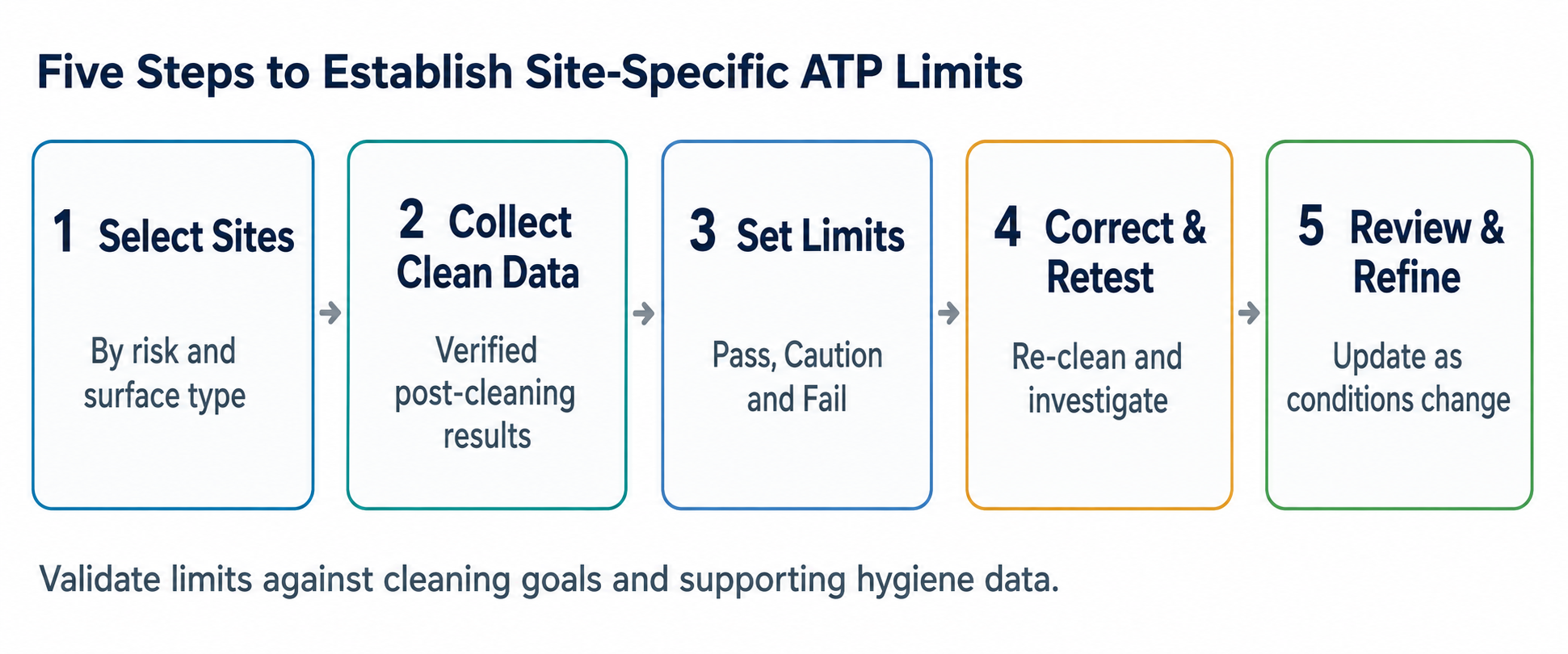
Figure 1. Risk-based workflow for establishing and maintaining site-specific ATP limits.
Interpreting Pass, Caution and Fail results
A three-level decision framework is often more useful than a single pass/fail cutoff:
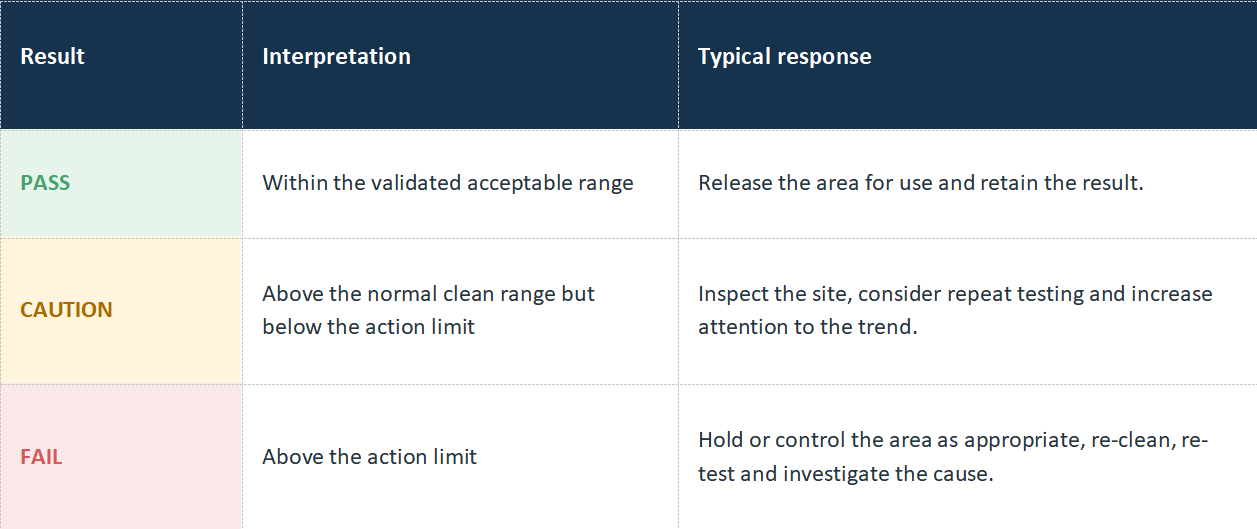
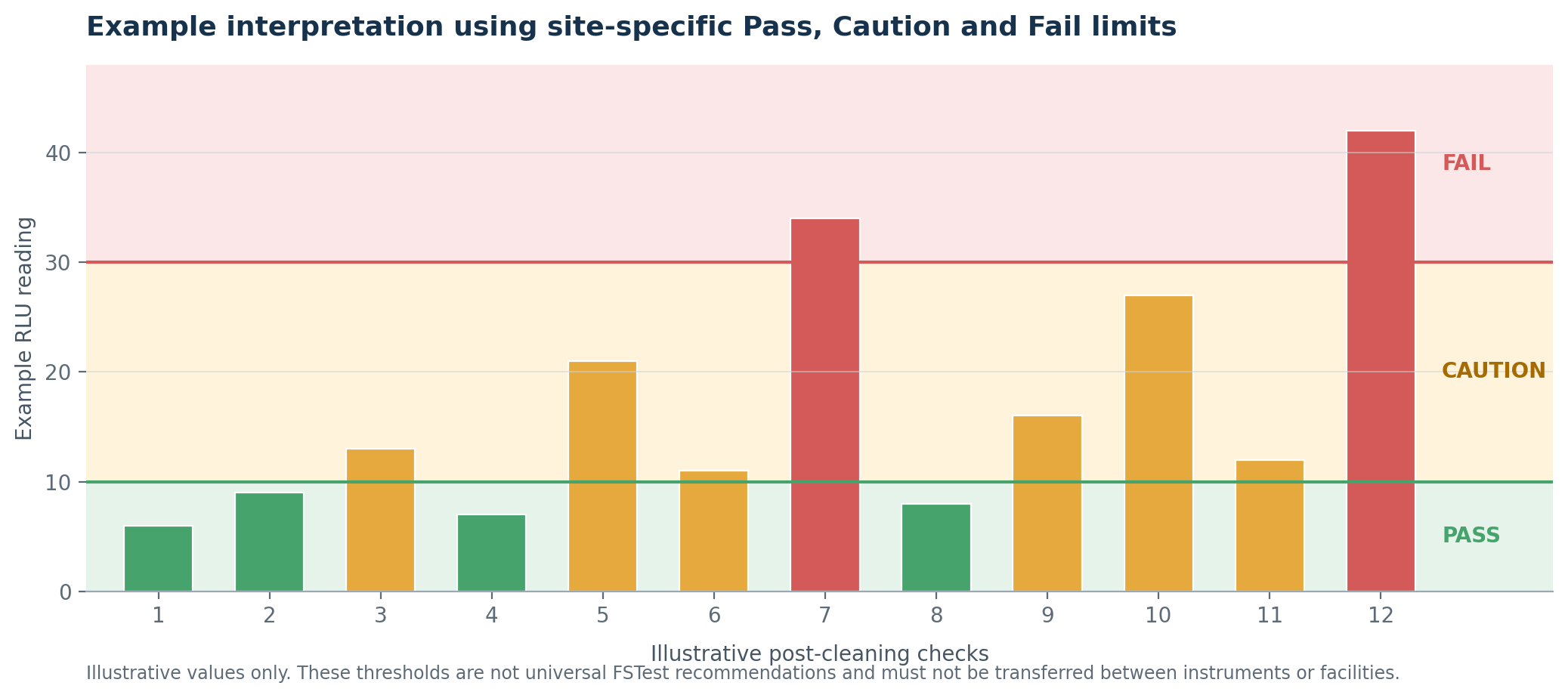
Figure 2. Illustrative interpretation only; the numerical limits are not universal recommendations.
IMPORTANT Use one ATP instrument and swab system consistently during baseline development and routine monitoring. Changing the instrument, swab formulation or test procedure may change RLU results and require re-establishment of the limits. |
ATP and microbiological testing play complementary roles
ATP testing answers an operational question: was the surface cleaned effectively enough to meet the facility’s established hygiene criteria at that moment? Culture-based testing answers a different question by detecting or enumerating viable microorganisms under defined conditions.
The two methods should therefore be interpreted as complementary evidence rather than expected to show direct numerical correlation. An acceptable ATP result does not prove the absence of pathogens, and an elevated ATP result does not identify the contaminant or confirm microbial growth.
Building a practical FSTest hygiene monitoring workflow
FSTest supports a layered approach to cleaning verification and environmental hygiene monitoring:
· MC200 ATP Hygiene Monitor (Cat. No. 50200) with FSTest ATP swabs provides rapid quantitative RLU results for routine cleaning verification and trend analysis.
· InstaPro Swab (Cat. No. 22102) and the Surface Hygiene Test Card (Cat. No. 21116) detect protein residues and may help determine whether protein soil is contributing to an elevated ATP result. A negative protein result does not establish that the ATP signal is microbial in origin.
· FSTest microbial count plates can support periodic microbiological environmental monitoring where culture-based assessment is required.
Need help establishing ATP limits for your facility?
Contact the FSTest applications team for support with sampling-point selection, baseline study design, operator training and result interpretation.
References
1. National Health Commission of the People’s Republic of China and State Administration for Market Regulation. GB 14881—2025, National Food Safety Standard—General Hygienic Practice for Food Production. Published 2 September 2025; effective 2 September 2026.
2. Bakke M, Suzuki S. A comprehensive analysis of ATP tests: Practical use and recent progress in the total adenylate test for the effective monitoring of hygiene. Journal of Food Protection. 2022;85(7):1079–1095.
3. Sogin JH, et al. Implementation of ATP and microbial indicator testing for hygiene monitoring in a food production facility. Applied and Environmental Microbiology. 2021;87(10):e02032-20.


 Log in
