




Building a Risk-Based Lead Screening Workflow for Food Ingredients
Lessons from a recent cinnamon recall for sampling, screening and confirmation
Rapid tests can strengthen ingredient controls only when representative sampling, matrix-specific verification and appropriate confirmation are built into the same workflow.
A Recent Recall Highlights a Persistent Supply-Chain Risk
On September 24, 2026, the U.S. Food and Drug Administration posted a company announcement concerning the voluntary recall of Lior Cinnamon Ground Seasoning after a state sample was found to contain elevated lead levels. The event highlights a wider challenge: lead may be unevenly distributed within a lot, while pigments, oils, particles and extraction efficiency can affect screening performance in complex food matrices.
Why Lead Screening Begins Before the Test
A rapid test can identify lots that may require investigation, but it cannot correct unrepresentative sampling or incomplete homogenization.
· Screening sorts samples by risk; it is not a quantitative compliance result.
· Confirmation identifies and quantifies lead using a validated laboratory method.
· Traceability links the result to the lot, supplier, operator and follow-up action.
A Five-Step Workflow
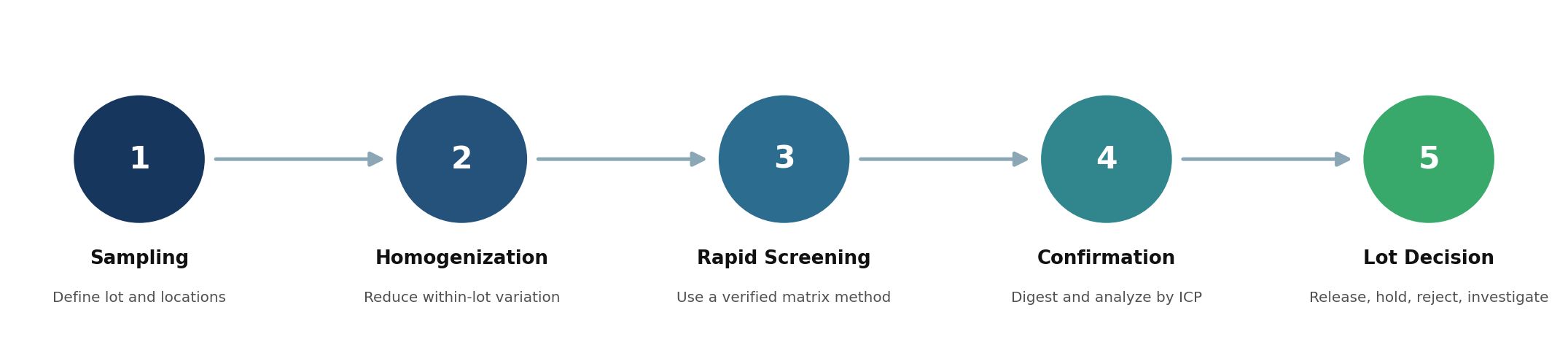
Figure 1. A risk-based pathway from representative sampling to a documented lot decision
1 Define the sampling unit.
Define the lot, increment locations, composite-sample strategy and acceptance rules before testing.
2 Homogenize the laboratory sample.
Reduce particle-size and concentration differences while controlling cross-contamination.
3 Apply a matrix-verified rapid screen.
Use the method only within its declared or independently verified matrix scope, with appropriate controls.
4 Confirm presumptive positive results.
Use a validated method, such as ICP-MS or ICP-OES after suitable digestion, for quantitative confirmation.
5 Make and document the lot decision.
Release, hold, reject or investigate according to documented procedures and applicable specifications.
Matrix Validation Defines Meaningful Performance
Performance cannot be transferred automatically between food matrices. A method verified in milk, drinking water or seafood should not be presented as validated for cinnamon or other spices without a separate matrix-specific study.
 Scope note. These products illustrate matrix-specific screening and are not presented as validated for cinnamon or other spices. Consult the current instructions for use for product scope and specifications.
Rapid Screening and Laboratory Confirmation Are Complementary
Rapid screening adds value by providing earlier warning and focusing laboratory resources on higher-risk samples. It does not replace confirmation; it connects a fit-for-purpose method to a predefined response.
Four Questions Before Routine Use
Before routine use, confirm that the workflow answers four questions:
· Matrix fit. Has the extraction and test response been verified for the specific ingredient?
· Decision point. Does the screening threshold support the intended hold, release or investigation rule?
· Confirmation. Which validated laboratory method will be used for presumptive positive or disputed results?
· Records. Can the result be linked to the lot, operator, kit lot and final disposition?
References
2. FSTest. Heavy Metal Pb Rapid Test Strip, Cat. No. 11108.
3. FSTest. Heavy Metal Pb Rapid Test Strip for Seafood, Cat. No. 24117.


 Log in
