




Enzyme Inhibition Screening for Pesticide Residues in Fresh Produce
A risk-based two-tier workflow for rapid screening and laboratory confirmation
Enzyme-inhibition testing can help receiving teams rapidly prioritize fresh-produce lots when organophosphorus or carbamate residues are a relevant concern. Its value is greatest as the first tier of a documented program—not as a substitute for compound-specific analysis.
Why risk-based screening matters
The U.S. FDA’s FY 2024 monitoring report covered 781 pesticides and selected industrial compounds in 3,528 human-food samples collected from October 2023 to September 2024. Because FDA sampling is risk-based, the figures below should not be read as population-wide violation rates; they illustrate why commodity, origin and supplier history should guide testing priorities.

What enzyme inhibition can and cannot do
The method detects reduced cholinesterase activity caused by certain organophosphorus and carbamate pesticides. It is fast and operationally simple, but it does not identify or quantify an individual compound. A screen-negative result also does not exclude pyrethroids, neonicotinoids, many fungicides or other residues outside the method’s response scope.

The decision rule is simple: use the rapid result to prioritize follow-up, then use an appropriately validated reference method whenever an individual pesticide or regulatory limit must be established.
Two tiers with different analytical roles

FSTest Pesticide Combo Card
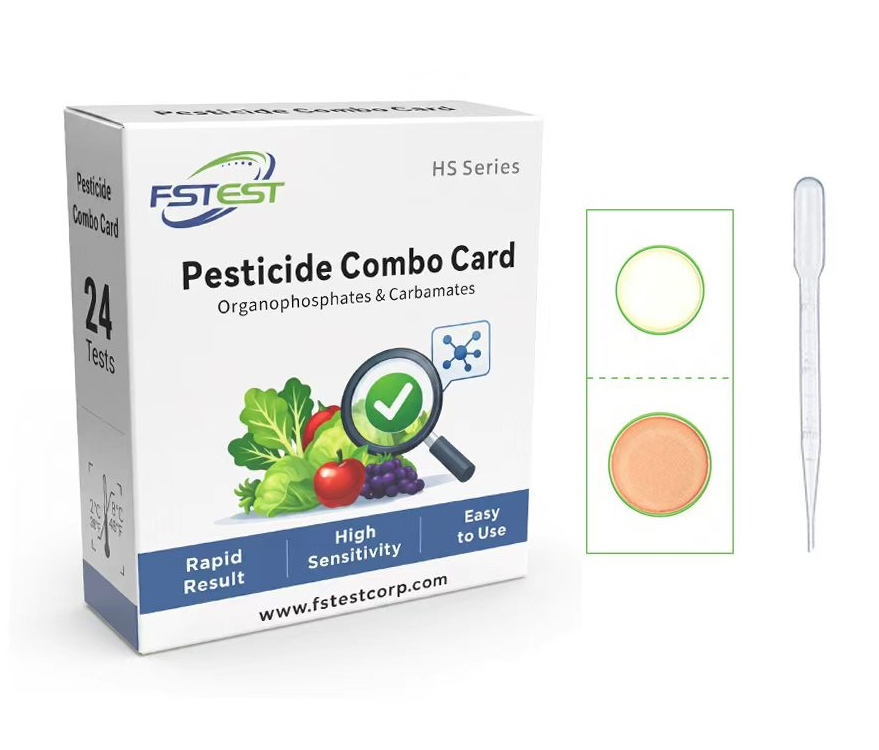
An instrument-free colorimetric card for preliminary screening of certain organophosphorus and carbamate pesticide residues in fresh vegetables, fruits, tea and other sample types covered by the current instructions and supported by matrix verification.
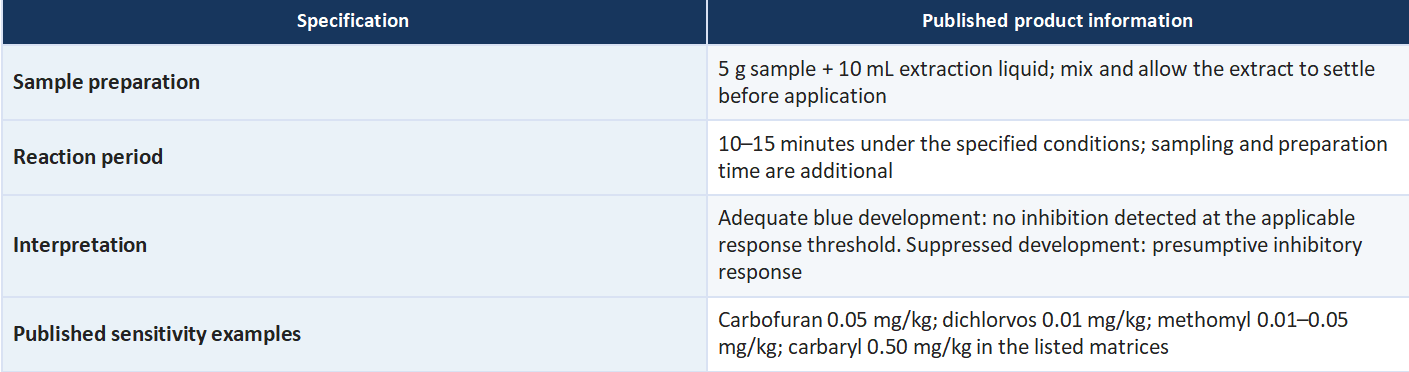
Interpret results within the method scope
· Published sensitivity figures are pesticide- and matrix-specific; they are not universal limits for all commodities.
· A detection limit is not the same as a regulatory maximum residue limit or U.S. tolerance.
· Use negative controls and matrix-appropriate verification. Positive controls should be managed by qualified personnel using suitable reference materials and documented procedures.
· Presumptive positive or invalid results require documented follow-up. Periodic laboratory testing is also needed to assess pesticide classes outside the rapid assay’s response range.
Used this way, the FSTest Pesticide Combo Card can support faster lot prioritization while preserving a clear distinction between preliminary screening and regulatory compliance verification.
References
1. U.S. FDA. FDA Releases FY 2024 Pesticide Residue Monitoring Report. 30 September 2026.
2. U.S. FDA. Pesticide Residue Monitoring Report and Data for FY 2024. 2026.
3. U.S. EPA. Tolerances and Exemptions for Pesticide Chemical Residues in Food. 40 CFR Part 180.
4. FSTest. Pesticide Combo Card product specifications and published validation summary.


 Log in

