


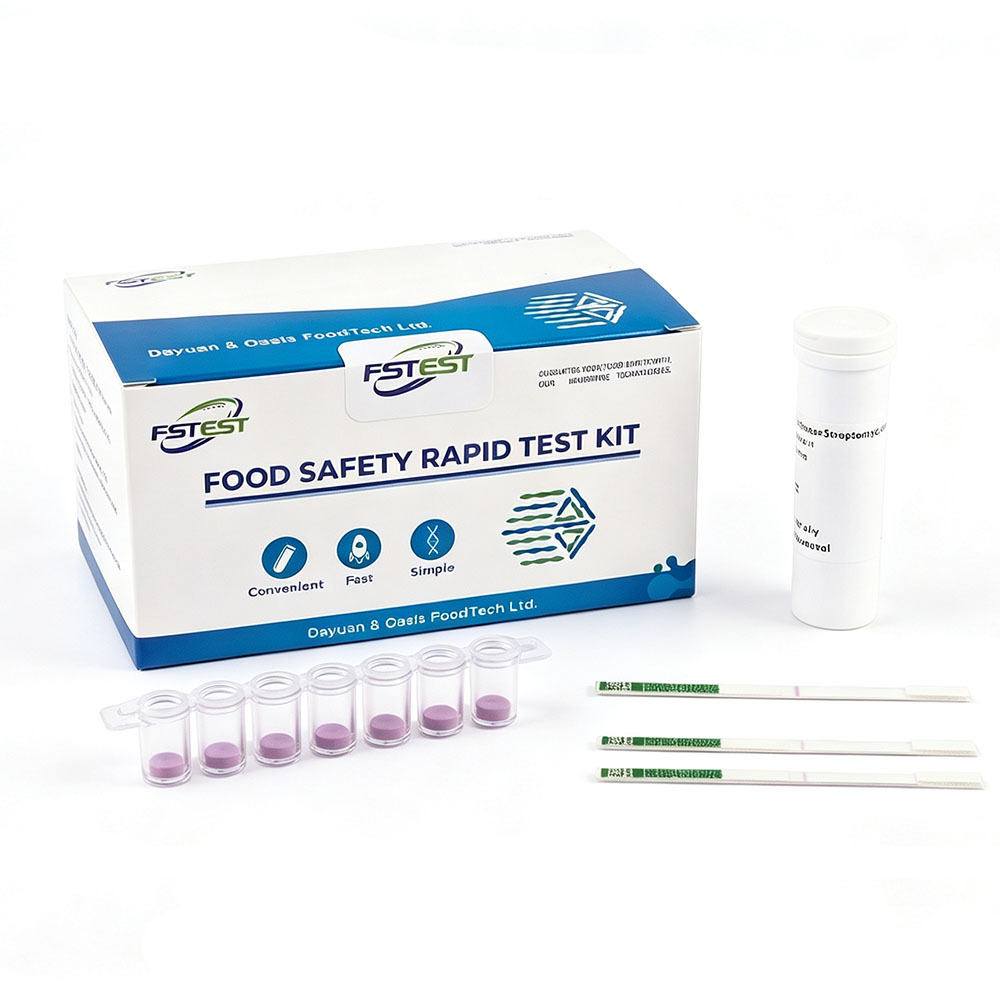
β-Lactams + Tetracyclines + Streptomycins + Chloramphenicol (CAP) + Tylosin 5-in-1 Rapid Test Strip
Brand: FSTest
8 mins Rapid Readout Time | 0.3 µg/kg Ultra-Strict CAP LOD | 96 Tests Commercial Bulk Pack | 24 Months Long Shelf Life |
The FSTest 5-in-1 Rapid Test Strip is a professional-grade, industrial multiplex screening tool engineered for the simultaneous, independent detection of five major high-risk veterinary drug residue categories in dairy products: Beta-Lactams, Tetracyclines, Streptomycins, Chloramphenicol (CAP), and Tylosin.
Antibiotic and antimicrobial residues in dairy production present critical food safety challenges and are subject to strict Maximum Residue Limits (MRLs) or absolute zero-tolerance prohibitions worldwide. By consolidating five distinct biochemical screenings into a single, straightforward assay loop, this kit eliminates the necessity for complex multiple extraction protocols or separate ELISA microplate platforms, compressing essential multi-residue milk verification into a simplified, field-ready workflow for dairy farms, collection stations, pasteurization plants, and QA laboratories.
High-Speed Field Screening: Maps out a comprehensive safety profile spanning five major contaminant groups in a single test sequence, providing clear visual results within just 8 minutes.
Ultra-High Sensitivity Thresholds: Calibrated to meet or surpass rigid regulatory cutoffs: Tylosin (10–20 µg/kg), Chloramphenicol (0.3 µg/kg), Streptomycins (50 µg/kg), Tetracyclines (5 µg/kg), and Beta-Lactams (2–4 µg/kg).
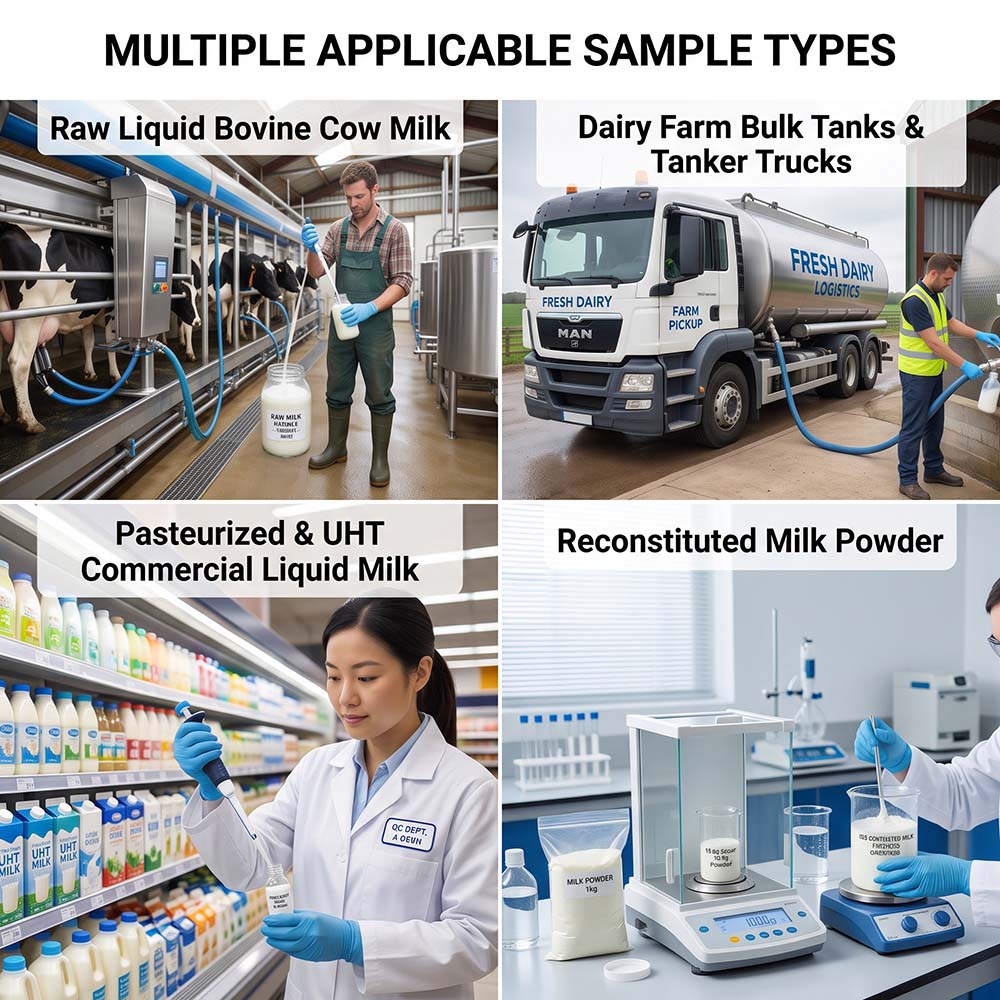
Extensive Dairy Matrix Adaptability: Formulated for multi-matrix sample validation, providing reliable results for raw milk, pasteurized liquid milk, and reconstituted milk powder.
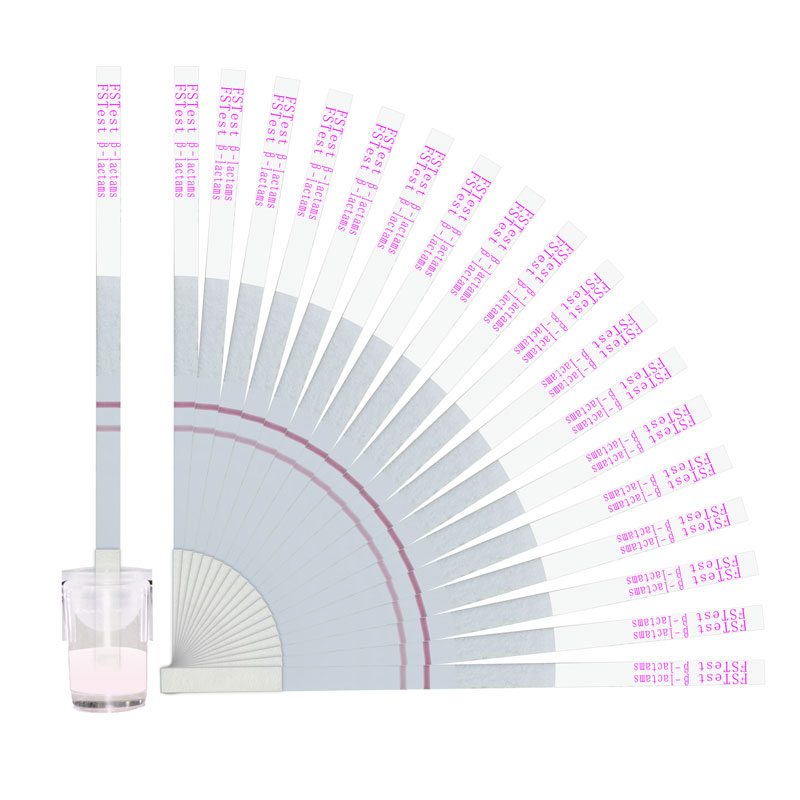
Zero-Ambiguity Visual Layout: Features five separate invisible Test lines (T1, T2, T3, T4, T5) paired with an integrated internal Control (C) line for clear reading without cross-line visual interference.
Heavy-Duty Commercial Specification: Supplied in a bulk 96-test pack (96 test strips and 96 dry-reagent precoated microwells) perfectly optimized for high-throughput batch auditing.
Institutional Shelf-Life Flexibility: Offers a full 24-month sealed storage lifespan (2–8°C) with an advanced ambient tolerance profile permitting room-temperature transport and field deployment for up to 30 days.
| Product Name | β-Lactams + Tetracyclines + Streptomycins + CAP + Tylosin 5-in-1 Rapid Test Strip |
|---|---|
| Assay Mechanism | Competitive Multiplex Lateral Flow Immunochromatography |
| Pack Size | 96 Tests / Kit (96 Test Strips + 96 Precoated Microwells) |
| Test Time | 3 minutes microwell incubation + 8 minutes strip reaction |
| Storage & Shelf Life | 24 months at 2–8°C; permits room-temperature transport/storage up to 30 days |
| 1–4. Target Analyte Compound | CAS Registry Number | LOD Threshold (µg/kg) |
|---|---|---|
| Tylosin tartrate (T1 Line) | 1405-54-5 | 10–20 µg/kg |
| Tilmicosin (T1 Line) | 108050-54-0 | 10–20 µg/kg |
| Chloramphenicol (CAP) (T2 Line) | 56-75-7 | 0.3 µg/kg |
| Streptomycin sulfate (T3 Line) | 3810-74-0 | 50 µg/kg |
| Dihydrostreptomycin (T3 Line) | 5490-27-7 | 50 µg/kg |
| Tetracycline (T4 Line) | 60-54-8 | 5 µg/kg |
| Chlortetracycline (T4 Line) | 57-62-5 | 5 µg/kg |
| Oxytetracycline (T4 Line) | 79-57-2 | 5 µg/kg |
| Doxycycline (T4 Line) | 100929-47-3 | 5 µg/kg |
| 5. Beta-Lactams (T5 Line) Compound | CAS Registry Number | LOD Threshold (µg/kg) |
|---|---|---|
| Penicillin G Sodium Salt | 69-57-8 | 2–4 µg/kg |
| Penicillin-V | 87-08-1 | 2–4 µg/kg |
| Piperacillin | 61477-96-1 | 2–4 µg/kg |
| Ampicillin Trihydrate | 7177-48-2 | 2–4 µg/kg |
| Amoxicillin Trihydrate | 61336-70-7 | 2–4 µg/kg |
| Oxacillin | 66-79-5 | 2–4 µg/kg |
| Cloxacillin | 61-72-3 | 2–4 µg/kg |
| Cefoperazone | 62893-19-0 | 2–4 µg/kg |
| Cephalonium | 5575-21-3 | 2–4 µg/kg |
| Cefacetrile | 10206-21-0 | 8 µg/kg |
| Nafcillin | 147-52-4 | 10 µg/kg |
| Cefpirone | 21593-23-7 | 10 µg/kg |
| Cephalothin | 153-61-7 | 10 µg/kg |
| Cefquinome sulfate | 118443-89-3 | 20 µg/kg |
| Ceftiofur | 80370-57-6 | 50 µg/kg |
| Ceftriaxone | 73384-59-5 | 100 µg/kg |
| Cefazolin | 25953-19-9 | 100 µg/kg |
| Cephalexin monohydrate | 23325-78-2 | 1000 µg/kg |
Extensively validated for multi-matrix dairy applications across the supply chain:
STEP 1 Sample Prep Equilibrate milk to 20–40°C. For powder, mix 1 g powder in 9 mL distilled water. Take out strips/wells and re-cap container immediately. | STEP 2 Mix & Incubate Pipette 150 µL milk into precoated microwell. Mix thoroughly by repeated pipetting and incubate for 3 min (at room temp if ≥ 20°C, or set incubator at 40°C). | STEP 3 Insert Strip Insert test strip with loading end facing down into microwell. Start timing immediately for lateral flow reaction. | STEP 4 Read at 8 Mins Read visual lines strictly at 8 minutes. Results become invalid after 10 minutes due to post-reaction chemical shifts. |
Negative (-): Control (C) and all five Test lines (T1, T2, T3, T4, T5) show strong, distinct red bands matching or darker than C-line. (All 5 groups below cutoff).
T1 Positive (+): T1 line is visibly lighter than C-line or disappears completely; Tylosin residue ≥ 10–20 µg/kg.
T2 Positive (+): T2 line is visibly lighter than C-line or disappears; Chloramphenicol (CAP) residue ≥ 0.3 µg/kg.
T3 Positive (+): T3 line is visibly lighter than C-line or disappears; Streptomycins residue ≥ 50 µg/kg.
T4 Positive (+): T4 line is visibly lighter than C-line or disappears; Tetracyclines residue ≥ 5 µg/kg.
T5 Positive (+): T5 line is visibly lighter than C-line or disappears; Beta-Lactams residue ≥ threshold limit.
Multiplex Positive (+): Multiple faded or absent T-lines indicate co-existing multi-drug contamination.
Invalid: Control (C) line fails to develop a visible color band. Re-testing with a new strip is required.
Adhere to strict operational parameters to ensure maximum screening accuracy:
Qualitative Screening Purpose: Engineered strictly for rapid qualitative prescreening and preliminary field audits. Confirmatory laboratory testing is recommended if necessary.
Air Exposure Window: Initiate test within 30 minutes after pulling strips from protective container to prevent moisture damage.
Meticulous Pipetting: Thoroughly resuspend dry microwell reagents via repeated fluidic pipetting; improper mixing impairs line color development.
Environmental Limits: Maintain operating relative humidity at 30%–80%. Avoid wind currents and testing above 40°C. Do not touch central white membrane area.
Dairy Portable Incubator Block (40°C): Constant temperature incubator block for standardized testing when ambient temperature is below 20°C.
Email: service@fstestcorp.com | Website: www.fstestcorp.com








 Log in
